


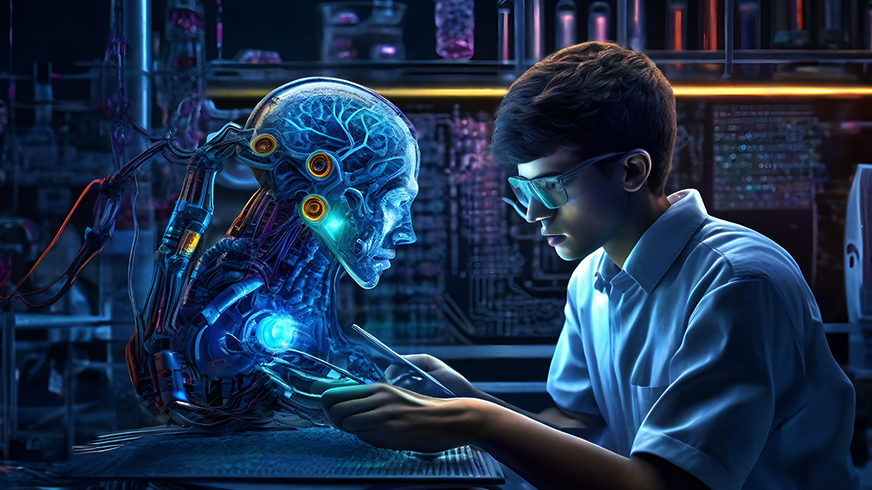
Generative AI is gaining momentum across industries. With our vision of Industrial Copilots along the entire value chain, we want to unlock this potential to improve human-machine collaboration and accelerate development and innovation cycles. Together with our partners, we make generative AI a reality for our customers on a broad scale.
Generative AI refers to technology that uses machine learning models to create content. Machine learning models are computer programs that seek to replicate aspects of human intelligence.
These models can produce various content formats, including code, text, visuals, audio, and video.
Various programs have the ability to learn almost any kind of information. For example, different generative AI models can understand coding, visual, scientific, and human languages.
Text Generation
Automated content creation (articles, stories), chatbots, and conversational agents.
Data Augmentation
Generating synthetic data to augment training datasets for machine learning models, which helps in improving model performance.
Generative AI models
Future Trends
Getting Started with Generative AI
Ethical and Responsible AI
frequently asked question
What is Generative AI?
Generative AI refers to artificial intelligence technologies designed to generate new, original content based on patterns learned from existing data. It includes the creation of text, images, audio, and other types of content, mimicking human creativity.
How do Generative AI models work?
Generative AI models work by learning the underlying patterns and distributions of data from a training set. Generative Adversarial Networks (GANs): Use two neural networks (generator and discriminator) that compete with each other. Variational Autoencoders (VAEs): Encode data into a latent space and then decode it to generate new samples. Transformers: Use self-attention mechanisms to handle and generate sequential data, especially effective in text generation.
What are some common applications of Generative AI?
Text Generation: Automated content creation, chatbots, and conversational agents. Image Generation: Art creation, style transfer, and deepfakes. Music and Audio Generation: Composing music, generating sound effects, and synthesizing voices. Video Generation: Creating video clips, animations, and video enhancement. Data Augmentation: Generating synthetic data to improve machine learning models. Drug Discovery: Creating and predicting molecular structures.